How to play Omaha poker (Pot-Limit Omaha)
Omaha looks like Texas Hold'em with two extra cards — and that small change makes it a completely different game. Bigger hands, bigger pots, more action. Here are the rules and the first things to learn.
The rules in one minute
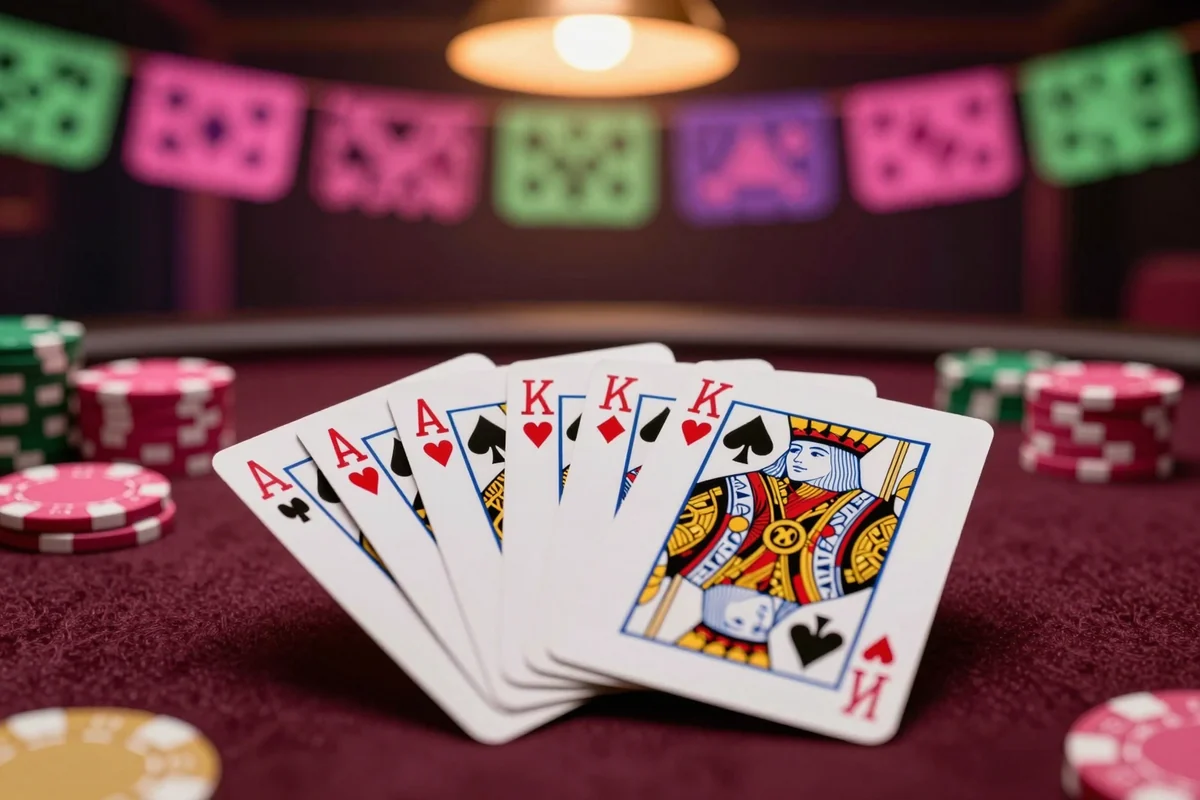
- Every player gets four hole cards instead of two.
- Five community cards come out exactly as in Hold'em: flop (3), turn (1), river (1), with a betting round after each.
- Your final hand must use exactly two of your hole cards and exactly three from the board. Not one, not three — two.
- Bets are pot-limit: the biggest raise you can make is the size of the pot.
The "exactly two" rule — where beginners lose money
This is the rule that catches everyone. Examples:
| Board | Your cards | Your hand |
|---|---|---|
| A♠ K♠ 7♠ 4♠ 2♦ | Q♠ J♥ 9♣ 8♦ | No flush — you hold only one spade, you need two |
| 9♦ 8♣ 7♥ 6♠ 2♣ | 10♥ K♣ K♦ 3♥ | No straight — only the 10 fits, you need two cards; your hand is a pair of kings |
| J♦ 10♦ 9♣ 3♠ 2♥ | Q♣ 8♥ K♦ 4♣ | Straight K-Q-J-10-9 (K♦ and Q♣ from your hand) |
The site always shows the best legal hand, but you need to see it yourself before you put money in.
How the pot-limit bet works
The maximum raise = the pot after you call. Example: the pot is $10 and your opponent bets $5. You first "call" $5 (the pot becomes $20), then you may raise by up to $20, so your total bet is $25. You don't have to count it: the table never lets the bet go above the pot.
Good starting hands
In Omaha you want four cards that work together:
- Double-suited hands (two cards of one suit, two of another) — two flush draws at once.
- Connected cards like J-10-9-8 — many ways to make a straight.
- High pairs with support, e.g. A-A-K-Q double-suited — the best hand in the game.
Avoid "danglers" — three good cards and one that does nothing (K-Q-J-3). And remember: four of a kind in your hand (8-8-8-8) is one of the worst starting hands, because you can use only two of them.
Five tips for Hold'em players moving to Omaha
- Hands run much closer. A-A before the flop is only a small favourite against a good four-card hand. Don't go all-in pre-flop with it.
- Draw to the best hand. A flush that is not the ace-high flush often loses. A straight that is not the top straight often splits or loses.
- Two pair is usually weak on a busy board.
- Position matters even more — the pots get big, and acting last is worth a lot.
- Start at the lowest stakes. Omaha has big swings; give yourself room.
Hold'em and Omaha are running right now — sit down in one click.
Open the cash tables →Omaha vs Texas Hold'em
| Texas Hold'em | Pot-Limit Omaha | |
|---|---|---|
| Hole cards | 2 | 4 |
| Cards used from your hand | 0, 1 or 2 | exactly 2 |
| Betting | No-Limit (any size) | Pot-Limit (up to the pot) |
| Typical winning hand | top pair, two pair | straights, flushes, full houses |
| Swings | moderate | high |
New to both? Read the Hold'em rules and the hand rankings first.
FAQ
Can I use three cards from my hand in Omaha?
No. In Omaha you must use exactly two hole cards and exactly three community cards.
What is the best starting hand in Omaha?
A-A-K-K double-suited (two aces and two kings, two cards of each of two suits).
Why is it called Pot-Limit Omaha?
Because the largest bet or raise allowed is equal to the size of the pot at that moment.
Is Omaha harder than Hold'em?
The rules are almost the same, but hands are stronger and swings are bigger. Start at the lowest stakes.
Read next
 Crypto poker: playing online poker with Bitcoin, USDT and ETHWhat crypto poker is, how deposits and withdrawals in BTC, ETH and USDT work, what it costs and how to start playing Hold'em and Omaha for crypto safely.
 Texas Hold'em rules: how to play, step by stepLearn Texas Hold'em in 10 minutes: blinds, pre-flop, flop, turn, river, showdown, betting actions and side pots, with simple examples and beginner tips.
 Spin & Go strategy: how to win the lottery sit & goSpin & Go explained: how the prize wheel and multipliers work, the real odds, and a simple push-fold strategy for short stacks and fast blinds.